Leadership Without Authority
There are few roles in aerospace as misunderstood as that of the Mission Assurance Manager.
To some, the MAM is the person who runs the risk board, owns the assurance plan, checks compliance, worries about reliability, or makes sure required reviews and deliverables happen. And, unfortunately, there is still the old stereotype of Mission Assurance as the “Quality Police”: the organization that arrives late, identifies everything everyone else did wrong, and explains why the program cannot proceed.
Those are fragments of the job, but they miss its real purpose.
The Mission Assurance Manager is a leader. More specifically, the MAM is an independent risk leader whose purpose is to help a program succeed.
What makes that role unusual is that the MAM typically possesses little of what we traditionally associate with organizational leadership. They may not control the budget or schedule, possess design authority, or directly manage the engineers and assurance specialists upon whom they depend. Yet they are expected to influence all of those things.
That creates one of the central paradoxes of Mission Assurance: the MAM carries significant responsibility for mission success while possessing relatively little formal authority to compel it.
So how do they lead?
Through credibility.
More than any technical specialty, certification, process, or organizational mandate, credibility is the most important asset a Mission Assurance Manager possesses.
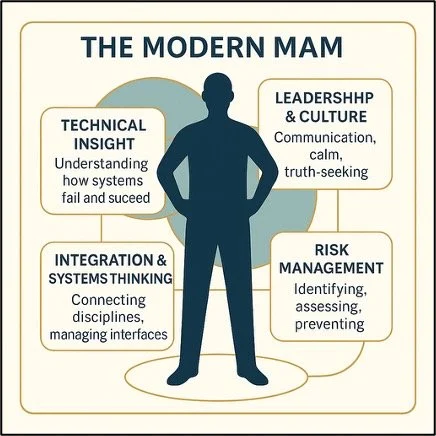
The MAM is not responsible for knowing everything, but they are responsible for knowing enough to connect the pieces together and see the whole risk picture.
An Independent Risk Manager on the Program
At its core, Mission Assurance is about identifying, understanding, communicating, and managing risk. That sounds simple until we consider what risk actually looks like on a real aerospace program.
Risk is rarely sitting politely in a risk register waiting to be managed. It is buried in interfaces, disguised as a schedule problem, or hidden in an assumption everyone has stopped questioning. It emerges from supplier decisions, manufacturing escapes, software changes, technical debt, test failures, inadequate margins, organizational behavior, and sometimes simple human reluctance to deliver bad news. Risk is uncertainty wrapped in technical complexity and influenced by cost, schedule, process, politics, culture, and personality.
The MAM does not own all of those risks, nor should they. The MAM's role is to help make them visible.
They help the program understand not merely whether a decision is allowed, but what that decision means. What assumptions support it? What evidence justifies it? What uncertainty remains? What happens if the team is wrong?
That makes the MAM neither an advocate for caution nor an obstacle to progress. Their loyalty is to mission success. Sometimes that means advocating for more rigor, testing, analysis, or time. At other times it means arguing against unnecessary process or assurance activities that consume resources without materially reducing risk.
To do this effectively, the MAM must occupy an unusual position: integrated with the program while remaining independent from it. Too close, and objectivity disappears. Too distant, and the MAM loses the context and trust necessary to influence anything.
The phrase I like to use for this is: On the program, but not of the program.
Credibility Is the MAM's Currency
A program manager can direct resources. A chief engineer possesses technical authority. A functional manager controls people and assignments. The Mission Assurance Manager often has none of those things.
What the MAM has instead is the ability to persuade.
When you cannot command, you must convince. When you cannot simply demand an action, you must explain why it matters. When people are not obligated to follow your judgment, you must become someone whose judgment they choose to trust.
It accumulates slowly through good judgment, technical insight, preparation, consistency, careful questions, and the ability to recognize important problems before they become obvious. It can disappear quickly when a MAM raises poorly supported concerns, cries wolf, or challenges a team without understanding the technical context.
This does not mean the MAM must be the smartest technical expert in the room. In fact, they rarely are. A propulsion engineer knows propulsion better. A reliability engineer knows reliability analysis better. A software engineer knows the software architecture better.
The MAM's competence is different. They must know enough to connect what those experts know.
That requires breadth across engineering, program management, operations, cost, schedule, Quality, reliability, safety, software, supply chain, and risk. No MAM will ever fully understand every technology used on a complex program. The objective is not omniscience, but sufficient fluency to recognize relationships, follow the logic, identify gaps, and ask the question that matters.
Sometimes the most credible words a MAM can say are simply, “Help me understand this.”
There is no loss of authority in acknowledging that someone else knows more about a technical subject. Engineers quickly recognize the difference between someone trying to demonstrate expertise and someone genuinely trying to determine whether the evidence supports the conclusion. In this manner, humility can be a technical skill.
Leadership Without Command
Mission Assurance leadership is therefore fundamentally different from conventional management. The MAM routinely influences decisions made by people who do not report to them.
That influence begins with integrity, but it is demonstrated through behavior: listening before arguing, understanding the issue before taking a position, framing concerns in terms others can understand, remaining calm under pressure, following through on commitments, and choosing carefully when to speak.
Being right is not enough. The MAM must also be effective.
An effective MAM learns to ask questions that reveal problems without attacking people. “Did you verify this?” and “What evidence gives us confidence that this condition is bounded?” may seek similar technical information, but they create very different conversations. The first can put a person on trial. The second puts the system under examination.
Over time, that approach creates something more valuable than formal authority: earned authority.
Engineers begin sharing concerns before they become formal issues. Program managers ask for the MAM's perspective before making decisions. Technical teams bring the MAM into conversations because they value the questions, not because a process requires their attendance. Customers call because they want an unvarnished assessment of what is actually happening.
That is leadership without command.
The MAM as Integrator
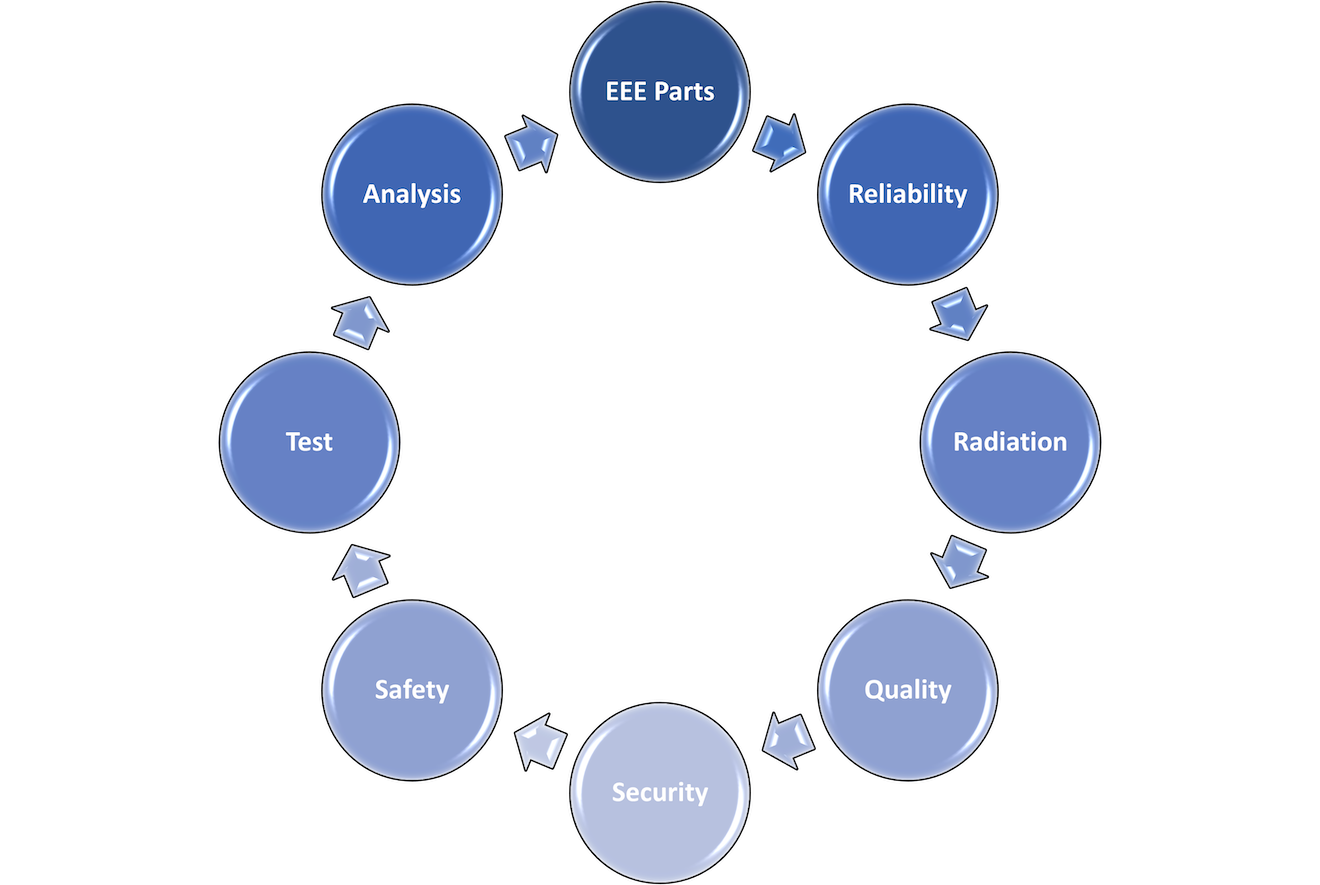
EEE Parts, Reliability, Systems Safety, Radiation Effects, Quality Assurance, Systems Test … and so much more. The power of Mission Assurance is that a team is made up of these functions instead of treating them separately. That way, risk is balanced across the program rather than stovepiped from one phase to another.
The MAM's leadership responsibility also extends to the assurance organization itself.
A modern aerospace program may draw upon Quality engineers, reliability specialists, EEE parts engineers, systems safety, software assurance, materials and processes, radiation assurance, contamination control, supply-chain quality, cybersecurity, and other specialists. Each may possess extraordinary expertise, but expertise does not automatically integrate itself.
Without leadership, Mission Assurance can become a collection of highly competent silos. Each specialist performs good work within a particular discipline while nobody looks across the seams.
The MAM turns those specialists into a team.
They ensure that the right expertise is engaged at the right time and at the appropriate level of depth. They protect disciplines that are being overlooked, rein in assurance activities that add burden without meaningfully reducing risk, and connect individual technical findings to the larger mission picture.
Most importantly, the MAM does not merely integrate assurance activities. They integrate risk.
A workmanship issue may reveal a supplier-management problem. A test failure may expose a requirements problem. A reliability concern may have implications for mass, power, cost, and schedule. A software anomaly may reveal weaknesses in configuration management.
Someone must look across all of those boundaries and continually ask:
What does this mean for the mission?
That is one of the MAM's most important responsibilities.
Seeing the Whole Program
Technical competence alone, however, is not enough to answer that question. A credible MAM must understand the realities under which programs operate.
Cost matters. Schedule matters. Customer commitments matter.
Recognizing those realities does not mean compromising technical integrity to protect them. It means recognizing that technical and programmatic risks are inseparable. A qualification failure can become a critical-path problem. Rework from a Quality escape consumes money and schedule. An unresolved technical issue can consume margin. And a mitigation without budget or time allocated to execute it is not much of a mitigation at all.
The effective MAM therefore understands cost, schedule, and program performance as well as the traditional assurance disciplines. Being able to translate a reliability concern into a potential schedule slip or financial exposure changes the conversation from “Mission Assurance is worried” to “Here is the consequence of this decision.”
That is a much more powerful position from which to influence a program.
The same principle applies to technical depth. The MAM does not need to calculate every RF link margin, write flight software, or conduct every fault-tree analysis. But they must understand enough to recognize when logic does not close, verification does not support the conclusion, or confidence exceeds the available evidence.
Their value lies in seeing the whole rather than owning every piece.
Structured Skepticism
Perhaps the most valuable tool a MAM develops is disciplined curiosity.

It’s about critical thinking at the systems level.
Mission Assurance should be skeptical, but it should never be cynical. Cynicism assumes something is wrong. Structured skepticism asks how we know it is right.
Instead of simply asking whether there is sufficient margin, the MAM asks how that margin was established. Rather than accepting that a requirement has been met, they ask what evidence demonstrates compliance, under what conditions, and with what uncertainty.
The MAM continually examines the chain between assertion, evidence, and confidence. They look for assumptions that have become invisible through repetition. They ask whether an analysis still applies after a design change and whether information has propagated across disciplinary boundaries.
The objective is not to catch someone being wrong. It is to help the system become better at catching itself.
This may be one of the MAM's greatest contributions to mission success. Over time, a good MAM changes how the program thinks. Engineers begin asking assurance questions themselves. Program managers ask what uncertainty lies behind a green status. Teams become more willing to expose problems early because they know the response will be constructive rather than punitive.
Eventually, assurance stops being something the MAM does to the program. It becomes part of how the program operates.
Confidence and the Customer
The same credibility that gives the MAM influence inside the program also gives them a unique relationship with the customer.
The program manager represents commitments and delivery. The chief engineer represents the technical solution. The Mission Assurance Manager represents something slightly different: Confidence.
When a mission encounters trouble, the customer needs someone who can answer the questions that matter: Do we understand what happened? Do we understand the risk? Are our decisions supported by evidence? Is the recovery plan credible?
The customer does not need optimism from the MAM. Nor do they need pessimism. They need an accurate assessment of reality.
That trust cannot be manufactured during a crisis. It is accumulated beforehand through candor, consistency, technical competence, and the willingness to communicate bad news as readily as good news. Eventually, the MAM's credibility itself becomes a form of assurance. When they say a problem is understood, the customer believes them because experience has shown that they would say so if it were not.
The Quiet Power of Mission Assurance
The Mission Assurance Manager occupies a difficult position. They must challenge without becoming adversarial, remain independent without becoming isolated, understand technical details without pretending to be the technical expert, protect rigor without worshiping process, and respect schedule pressure without becoming captured by it. Sometimes they must tell powerful people things they very much do not want to hear.
Doing that well requires technical competence, judgment, emotional intelligence, resilience, humility, courage, and restraint.
The best MAM is not necessarily the person who speaks most often or raises the most risks. It is the person whose words carry weight when they do speak.
That is why credibility matters above everything else.
Without credibility, the MAM is another compliance reviewer. With credibility, the MAM becomes a trusted advisor—and eventually something more valuable: a steady presence within the program. Someone engineers and technicians trust enough to expose uncertainty to. Someone leaders rely upon when the answer is not obvious. Someone customers believe when things go wrong.
The MAM does not build the spacecraft, they do not own the mission, and they cannot guarantee its success.
But they can help an organization see risk clearly. They can connect information that would otherwise remain isolated and expose assumptions before those assumptions become failures. They can create an environment in which engineers tell the truth, leaders understand the risks they are accepting, customers have confidence in what they are being told, and difficult decisions are made with eyes open.
And when a Mission Assurance Manager has earned sufficient credibility, they can do all of this without commanding anyone.
It’s not administration, and it’s not simply compliance.
It is leadership.
And in a business where the difference between mission success and failure can come down to one overlooked assumption, one unheard engineer, or one decision made without understanding its consequences, that leadership can make all the difference.
AI-assisted synopsis of Chapters 16 and 17 of The Tao of Mission Assurance
