Program Management, Engineering, and Mission Assurance
One of the most enduring concepts for how Mission Assurance Managers integrate into space systems development programs is the “Three-Legged Stool,” a model that describes the relationship among Program Management, Engineering, and Mission Assurance within a technical program. I personally prefer a different name: the “Golden Triangle.” More on this further on …
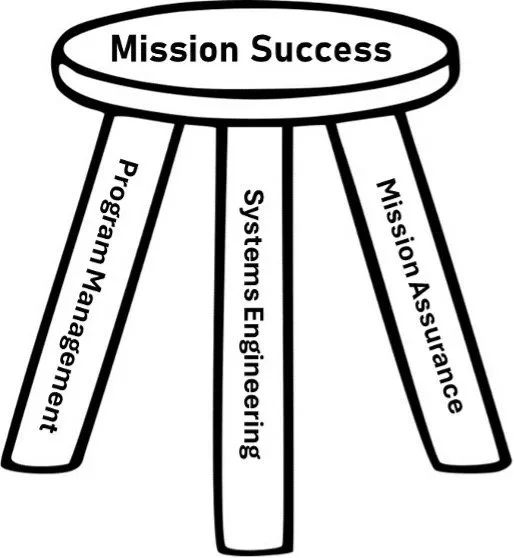
Borrowed from NASA Jet Propulsion Laboratory, the Three-Legged-Stool symbolizes how the three leadership functions of Program Management, Systems Engineering, and Mission Assurance must work together to achieve “Mission Success”.
The traditional stool analogy is useful because it illustrates a simple truth: remove one leg, and the structure collapses. Successful development programs require disciplined management of cost and schedule, comprehensive technical design and performance, and an appropriate amount of engineered-in quality and reliability. These functions are different, but deeply interdependent.
In simplest terms:
Program Management owns cost and schedule.
Engineering owns technical design and performance.
Mission Assurance owns confidence in mission success.
The relationship sounds balanced and straightforward in theory, but in practice, it rarely is.
Programs are not democracies. Budget authority, technical authority, and organizational influence are unevenly distributed. The Program Manager (PM) typically carries formal ownership of the program cost, schedule, and risk. The Chief Engineer (CE) owns the technical baseline, performance metrics, and requirements verification. The Mission Assurance Manager (MAM), however, while responsible for the achievement of high-quality and reliable systems, most often operates through influence rather than direct authority. When these three parties are well aligned, the program can effectively manage risk, achieve the technical baseline, and deliver on time and on budget. Yet, when not well aligned, the risk of failing to meet mission objectives goes up.
The Mission Assurance Manager must frequently earn a seat at the table through competence, judgment, communication, and trust.
Influence must be earned, rather than mandated via an org-chart.
This reality is one reason why Mission Assurance is sometimes misunderstood or even resisted on a program. To understand why, it is helpful to briefly examine where the Mission Assurance and the Mission Assurance Manager leadership role came from and how it evolved into its modern form.
The formation of Mission Assurance as an integrated set of disciplines
Mission Assurance as an integrated set of disciplines largely emerged during the formative decades of the American space program. Although quality control, safety engineering, and reliability analysis existed long before Apollo, the idea of organizing these functions into a unified mission-focused effort gained prominence during the 1960s and 1970s.
As space systems became more complex, expensive, and operationally critical, organizations recognized that mission success depended on more than simply producing hardware that met specifications. Missions required disciplined integration of quality, reliability, safety, radiation effects analysis, configuration management, and risk management throughout the lifecycle of development and operations.
NASA’s Jet Propulsion Laboratory (JPL) became one of the early leaders in formalizing this approach. Faced with ambitious deep-space missions operating in unforgiving environments and at extreme distances from Earth, JPL adopted a development philosophy emphasizing reliability, redundancy, workmanship quality, and independent technical oversight. Their “Mission Assurance Program” framework integrated multiple specialty engineering and assurance disciplines into an organization independent from program execution and design engineering. And due to this independence, they instituted the role of the Mission Assurance Manager to independently run the “program within a program” and achieve mission success in conjunction with the PM and CE.
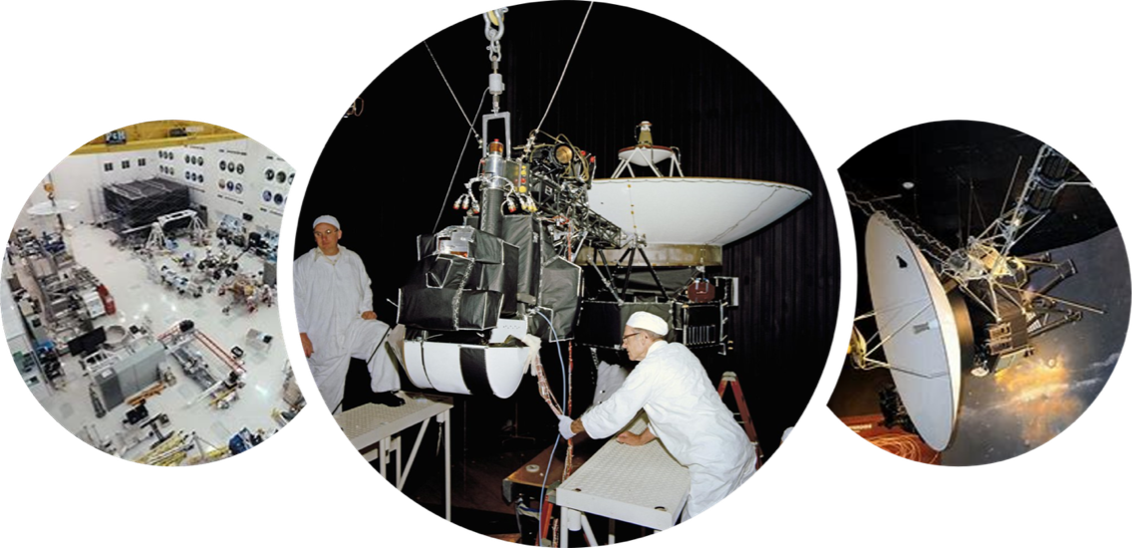
NASA Jet Propulsion Laboratory created and championed the Mission Assurance Program, and the institution of the Mission Assurance Manager - Technical risk leadership for aerospace and mission-critical systems.
The purpose was not to impede engineering, nor unduly drive cost and schedule, but to provide confidence that the mission would succeed and act as an independent risk owner.
The importance of this philosophy became dramatically clear following the 1986 Challenger disaster. The Rogers Commission identified several organizational and technical failures that contributed directly to the accident, including poor communication, normalization of risk, inadequate engineering analysis, and excessive pressure to meet cost and schedule objectives.
In many ways, the findings reinforced the need for an independent organization capable of raising concerns, evaluating risk objectively, and ensuring that critical technical information was heard at decision-making levels. Following Challenger, Mission Assurance became more formalized across NASA and much of the aerospace industry.
Over time, this led to the modern concept of the MAM: an independent technical leader responsible for integrating assurance disciplines into the program, participating in risk and engineering review boards, evaluating compliance to requirements and processes, and helping leadership understand the relationship between technical decisions and mission risk.
At its best, Mission Assurance is not “quality police.” It is risk stewardship in service of mission success.
The "Golden Triangle" in place of the "Three-Legged-Stool."
This is where the Golden Triangle becomes more useful than the Three-Legged-Stool, as a construct for explaining how the MAM and the MA team should show up on the program.
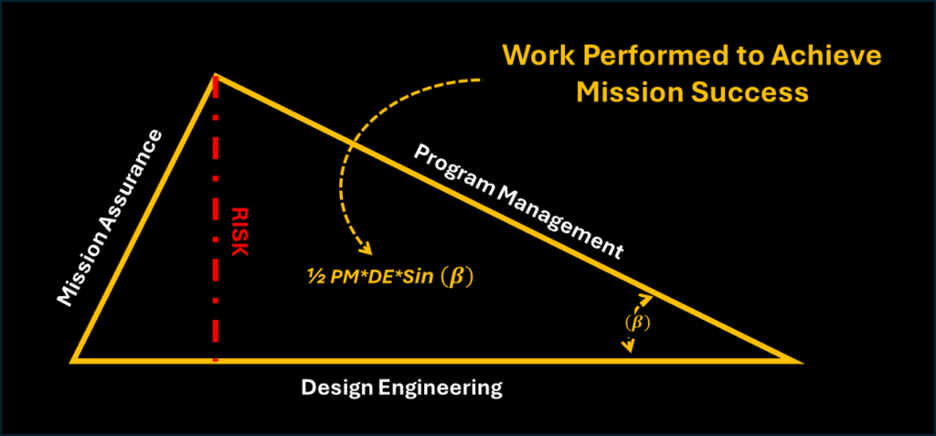
The Golden Triangle describes the inter-relation of Program Management, Design Engineering, and Mission Assurance, in terms of program risk posture.
The three sides of the triangle represent three distinct but interconnected leadership functions:
Program execution
Technical execution
Risk and assurance management
Each contributes differently to mission success. And the sides are not equal because the resources, responsibilities, and authority associated with each function are not equal. A technical development program naturally allocates most of its personnel, funding, and authority to management and engineering activities. Mission Assurance exists not to replace those functions, but to strengthen them by improving confidence in the overall outcome.
Engineers don’t design a system intending failure. And no program manager intentionally accepts an unnecessary risk. Yet history repeatedly demonstrates that capable teams and people can still drift into dangerous conditions when communication breaks down, assumptions go unchallenged, or organizational pressures overwhelm sound technical judgment.
The MAM role exists to help prevent this drift.
The highest-performing programs rarely operate with rigid organizational boundaries between these functions. Instead, strong programs develop trust and shared mission ownership between the Program Manager, Chief Engineer, and MAM. The best leaders expand their understanding beyond their primary functional areas and begin thinking holistically about mission success.
A strong Program Manager should understand technical risk.
A strong Chief Engineer should understand programmatic realities.
A strong MAM understands both and seeks to balance forces towards the best possible mission outcome.
When this relationship matures, Mission Assurance will transition from being viewed as an external oversight function into a genuine mission partner. Discussions will become less adversarial and more collaborative, problems will surface earlier, and risks will be communicated more openly.
Ironically, the best Mission Assurance organizations will become almost invisible. Healthy engineering discipline and risk awareness simply become part of how the program operates. What this really means is that the MAM has succeeded in establishing a culture of quality, performance, and risk ownership.
Achieving the Golden Triangle
Like the Three-Legged-Stool, the Golden Triangle should be thought of as an ideal to be strived for, rather than an objective to be achieved. Still, the pursuit of the right balance and earning the necessary technical credibility to be truly effective is never easy.
In commercial aerospace companies, especially, Mission Assurance organizations often operate under significant cost and schedule constraints. Unlike some government environments where assurance functions may be funded independently from the program, commercial programs must carefully balance rigor, speed, affordability, and acceptable mission risk. This tension can create friction when assurance activities are viewed primarily as overhead rather than mission-enabling investments.
Additionally, many engineers and managers simply have not experienced a highly effective Mission Assurance organization. Some may have encountered assurance teams disconnected from operational realities or overly focused on procedural compliance rather than mission outcomes. In those environments, Mission Assurance can unfortunately become associated with bureaucracy instead of value creation.
For this reason, the most effective MAMs build credibility by understanding the mission, solving problems proactively, and being the person others trust when discussions become uncomfortable. They become trusted advisors rather than external auditors. They understand that protecting mission success also includes protecting cost, schedule, and organizational effectiveness.

The Golden Triangle is an ideal to be strived for, not an objective to achieve. The MAM must commit time, presence, and the most precious of MAM currency, technical credibility.
Requirements compliance and the generation of deliverables are only a small part of the MAM role. The MAM is responsible for integrating multiple technical disciplines, balancing competing program priorities, identifying emerging risks, and helping maintain alignment between technical reality and program decision-making. In many respects, the role becomes the technical conscience of the program: an independent voice focused not on organizational politics, but on long-term mission success.
The Golden Triangle, therefore, represents more than three organizational functions. It represents the continual balancing of execution, design, and risk in pursuit of successful missions.
That balance may never be perfect. But the closer a program comes to achieving genuine trust and partnership between Program Management, Engineering, and Mission Assurance, the greater its ability to deliver successful and resilient systems.
For Mission Assurance professionals, this becomes the real objective: not simply enforcing compliance but continuously striving to become a trusted and indispensable mission partner.
AI-assisted synopsis from Chapters 1 and 3 of The Tao of Mission Assurance
